Archive for August, 2011
Cindy on August 31st, 2011
The grace to be a beginner is always the best prayer for an artist. The beginner’s humility and openness lead to exploration. Exploration leads to accomplishment. All of it begins at the beginning, with the first small and scary step.” — Julia Cameron
Remember the late-summer thrill of buying notebooks, Magic Markers, and bright yellow Ticonderoga pencils for a new year of grade school? And who could forget the incomparable scent of a fresh box of Crayolas? For me, the ritual of buying school supplies softened the hard reality of summer’s end.
Even if your kids have flown from the nest, the beginning of the new school year still inspires personal growth and renewal.
Is there a dormant passion you’d like to rekindle? A hobby waiting for you to explore? My new column on Royal Oak Patch details the first season my son left home for college, and how I started a new “term” in the school of lifelong learning. Included with the essay are several photos of my art projects. Please click here to read it. — Cindy La Ferle
Cindy on August 23rd, 2011
My eyes like old glass windows, dusted with lost days, are ready to hold the new light.” — Margo LaGattuta, from “Pretending to Be a Barn”
I found the e-mail from another writer-friend early this morning. It wasn’t unexpected, though I’d learned only two days ago that Margo LaGattuta was suddenly terminally ill.
“Margo died peacefully tonight, surrounded by her sons and sisters and friends….It was quite beautiful and I just know she’s writing a poem about it….”
It’s never easy to lose a mentor or a friend, and the best we can hope for is one last chance to say thank you. Which is why I am grateful to writer Carolyn Walker for contacting me this week — just in time to make it to the hospital to see Margo yesterday morning.
Over the years, Margo became a treasured friend. Whenever we were speaking at the same writers’ conferences, or attending literary events around town, I loved spotting her smiling face and wild bohemian outfits in the crowds of more conservatively dressed journalists and writers who were attending the programs. She always looked every inch the poet — the unbridled creative spirit — that she was.
She interviewed me for her radio show (“Art in the Air”/ WPON) after my first book was published in 1994, and in the process, I learned a thing or two from Margo about book promotion. Later on, it meant the world to me when she agreed to be the keynote speaker at the banquet when my second book, Writing Home, was awarded “Book of the Year” by Think Club Publications in 2006. There was also a time when the two of us wrote columns for the same newspaper, so we’d often chat on the phone when we had trouble navigating the ever-changing seas of print journalism.
But our relationship began as teacher and student. It seems that whenever I was going through a dry spell, or felt lost and blocked, Margo happened to be offering a local creative writing workshop that would shake me out of myself and inspire me to start writing again. In particular, I remember a weekend workshop at Cranbrook in Bloomfield Hills, about 18 years ago, which I attended a month after my father died. That same year, the travel magazine I’d been editing for five years suddenly folded — and I had no idea what to do next. I was blocked and sad.
But after that weekend workshop at Cranbrook, I felt as if the fog had magically lifted. Margo helped me find new ways to express my grief, and best of all, I got back on my proverbial horse and rode off to one of the most productive periods of my writing life.
I know I’m only one of hundreds (or thousands) claiming to be moved and changed by Margo’s “Inventing the Invisible” workshops, not to mention all the students she inspired in her college English classes over the years. Her encouragement launched countless writing careers. And, of course, we all deeply admired her poetry, newspaper columns, and essays. Shocked by her sudden passing, many of us are asking: Where will we find another Margo?
I am going through another rough period now, as my widowed mother is slowing drifting down the foggy river of dementia, and requiring much of my time and care. Once again, I’m at a creative impasse. When I arrived at Margo’s bedside at the hospital yesterday, I desperately wanted to say: “Margo, I need your advice again.” Instead, I simply thanked her for everything — for introducing me to some of my favorite poets, including Billy Collins and Mary Oliver and Margo LaGattuta. I told her I was grateful for all the times she helped rescue and refuel my creative soul. I also told her that Billy Collins had just come out with a new book of poems, and that I didn’t think they were as good as his earlier stuff. She was unable to speak, but she smiled.
Tonight I’ll pull down Margo’s books of poetry from my shelves and reread my favorites. Here is one from The Dream Givers (Lake Shore Publishing; 1990). It’s an early poem that, for me, conjures the light and spirit Margo brought to her work, her students, her creative life:
I CAME BY A RIVER
and the journey flashed
through me like a light
year. Some electric sound
got me moving from
the original place over
mountains and dusty
windows outside of time.
I became a small shadow,
something anyone might have
missed. I began spinning
deep in tomorrow’s orchard.
I came by a river
and the water keeps rising.
I came to begin something wild.
(By Margo LaGattuta; 1990; Lake Shore Press.)
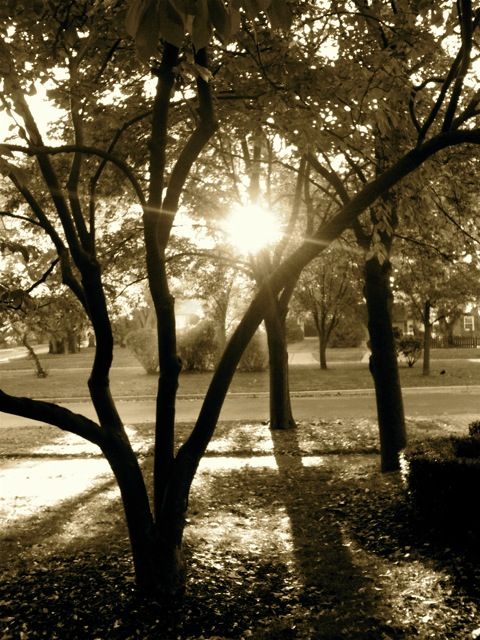
– Top photo: “Morning in Vinsetta Park” by Cindy La Ferle; 2010 –
___________
MEMORIAL POETRY READING
Celebrate Margo and her poetry Wednesday, August 31, 7 – 10pm, at the Lido Gallery in Birmingham. Bring ONE of your favorite Margo poems to read aloud to honor her memory. This event is free to the public.
COMMUNITY LIFESTYLES REMEMBERS MARGO
The September 5 issue of Community Lifestyles, where Margo published her popular “Word in Edgewise” columns, will be devoted to her memory. This issue will include a new piece I wrote, detailing Margo’s influence and impact on the metro-Detroit writing community. Watch for the issue online or in your mailbox if you live in the area.
Cindy on August 18th, 2011
Are we halfway through August already? Since “back to school” is the topic of the week (and I’m still on sabbatical), I’m sharing a piece I wrote for MetroParent not long after my son flew off to college….
Field notes on an empty nest
Last week I found a bird’s nest on the brick walk leading to our backyard. I’m guessing the nest fell from a nearby silver maple; or maybe a neighbor found it while jogging and left it by the garden gate for us to admire.
Not much larger than a cereal bowl, the nest now perches indoors on a shelf near my desk. Crafted from hundreds of delicate twigs, strands of grass, and patches of moss, it’s truly a work of art — and a timely reminder to prepare for my son’s return to college after the long summer break.
Children of baby boomers are heading off to college in greater numbers than children of previous generations. At the same time, the age-old ritual of “letting go” is the final frontier for those of us who’ve made child rearing a major focus of our adult lives.
I’ve been discussing this tender rite of passage with other middle-aged parents. And we all agree there has to be a better term to describe our next season of parenting – something that doesn’t sound as final or forlorn as “The Empty Nest.” Our nests, after all, are not completely empty. Not yet. My only child, for example, still has a bedroom here at home in addition to a loft in a crowded dormitory four hours away in South Bend, Indiana.
Whatever you want to call it, this to-and-from college phase is a thorny adjustment for parents and their almost-adult kids. College students are bound to ignore house rules when they return home for summer and holiday breaks. (“Curfew? What curfew?”) Even the most agreeable families discover that this can be a volatile time – a time when teen-aged tempers ignite and middle-aged feelings get scorched. All said and done, we’re all learning how to grow up and move on.
“When mothers talk about the depression of the empty nest, they’re not mourning the passing of all those wet towels on the floor, or the music that numbs your teeth…. They’re upset because they’ve gone from supervisor of a child’s life to a spectator. It’s like being the vice president of the United States.” — Erma Bombeck
A lot has changed since my son started college. I’m still adjusting to the hollow echo of his (oddly) clean and empty bedroom, looking for remnants of my old self — my mothering self — in the bits and pieces he left behind. The family calendar in our kitchen has some blank spaces, too, and is no longer buried under neon-color sticky notes announcing band concerts, Quiz Bowl meets, school conferences, and carpool schedules. At first, this was not cause for celebration. I’d become what our high school mothers’ club affectionately refers to as one of the “Alumni Moms.”
While I suddenly found myself with unlimited bolts of time to devote to my marriage and writing career, I mourned what I perceived to be the loss of my role as a hands-on parent. Despite the fact that I had a cleaner, quieter house, I missed all the athletic shoes and flip-flops piled near the back door. I missed the boisterous teenagers gathered around the kitchen counter, or in front of the television downstairs. I missed bumping into other parents at school functions, and wondered if life would ever be the same.
Life isn’t the same, but I’m OK with that now. I’ve come to realize that a mom is always a mom, even though her parenting role changes over time.
Not long ago, I stayed at my own mother’s place for a few weeks while I recovered from major surgery. When I apologized for disrupting her normal routine, she said, “My home will always be your home, too.” I found comfort in knowing that. Yet at the same time, I missed my own house. And I felt grateful that Mom had encouraged me, years ago, to craft a life — and a home — of my own.
It’s hard to believe my son is packing for another year of college this week. The hall outside his bedroom is now an obstacle course of boxes, crates, and suitcases stuffed with everything he needs for the months ahead. I’m still not very good at saying good-bye when his dad and I leave him at the dorm and steer our emptied SUV back to the expressway. I manage to compose myself until I notice the tearful parents of college freshmen going through this ritual for the first time. But it does get easier each term.
So, is the nest half-full or half empty?
Reflecting on the small bird’s nest perched near my desk, I’ve come to believe that every family is a labor of love and a work in progress. It’s a bittersweet adjustment, but I’m at peace with the idea that our household is just one stop on our son’s way to his future. He’ll be flying back and forth over the next couple of years or so. And hopefully, patience and love will be the threads that weave our family together, no matter how far he travels. – Cindy La Ferle, September 2006
– Top photo: Detail from “Nature,” a mixed-media collage by Cindy La Ferle. Bottom photo (nest) by Cindy La Ferle –
Cindy on August 16th, 2011
Draw a crazy picture,
Write a nutty poem,
Sing a mumble-gumble song,
Whistle through your comb.
Do a loony-goony dance
‘Cross the kitchen floor,
Put something silly in the world
That ain’t been there before.” — Shel Silverstein
Yes, I’ll admit that I love a good poop joke. And I love it when I stumble on something that tickles my funny bone when I least expect it.
Walking to the local Trader Joe’s for groceries today, Doug and I discovered the sidewalk commentary, at left, printed in newly poured concrete. Clearly, somebody’s inner child was gleefully responsible for this. It made me laugh so hard that I had to come back to take a photo after the morning shadows shifted away from the sidewalk.
I’m now inspired to look for a “fresh discovery” that makes me smile — no matter how small — every morning when I go for walks. No matter how old we are, we all need reminders to stop taking everything too seriously, right? — CL
– Photo by Cindy La Ferle –
Cindy on August 10th, 2011
Life is the sum of all your choices.” ~Albert Camus
I’m a little envious of friends and neighbors who have summer cottages in northern Michigan, where I’m always considered a tourist (or “fudgie”) no matter how often I visit.
Regardless, the opportunity to collect a few beach stones for my garden in suburban Detroit remains a highlight of my regular escapes to the shores of Lake Michigan. And while summer is quickly drawing to its close, we’ve still got a few precious weeks left to comb our Michigan coasts for treasure.
What to look for
A longtime collector, I’ve learned through experience that morning is the best time to hunt for beautiful beach stones. The water is usually calm, my outlook is refreshed, and, if I’m really lucky, my fellow beachcombers are still asleep. Rising with the sun, I get first pick of the gems that washed ashore.
If you’re planning a visit to northwest Michigan’s shores, I’d advise you to keep an eye out for exceptional Petoskey stones, which seem to be getting rare these days. But don’t overlook the subtle luster of milky quartz or the chance to grab a handful of perfect skipping stones that were tumbled smooth by the waves.
Look closely, and you might find stones imprinted with fossils, some bearing an uncanny resemblance to ancient tablets carved with runes or hieroglyphics. Others are miniature works of art, which you’d swear had been painted by an Asian calligrapher. As many Michigan jewelers have already discovered, some of these beauties are worthy of stringing on a necklace.
During a recent visit to the Sleeping Bear National Lakeshore, it occurred to me that collecting beach stones is a bit like crafting a life: You have to remain grounded and focused, yet always open to new possibilities.
Choices and more choices
For starters, you need deep pockets to contain your bounty. And you must begin the quest believing you’ll be rewarded with more than you bargained for.
If you focus solely on the obvious (Petoskey stones, for instance) you’ll miss the other jewels of the lake. In my search for something rare or perfect, I’ve nearly overlooked more humble specimens of beauty and character. As every seasoned beachcomber knows, the rippling water teases like a mirage, making it hard to see things as they really are. I’ve rescued many stones that looked tempting under water, but were lackluster when they dried in the sun. Some were merely pieces of beach glass.
The “rules” for collecting beach stones apply to choosing what’s essential in life: good friends, a supportive partner, the right school, a career path, community, and a place (or two) to call home. In other words, it’s wise to make your choices slowly and carefully; to consider what feels right, lasting, and true.
As the cliché goes, it’s also possible to have too much of a good thing — and beach stones are no exception. After a week at the beach, I always end up with too many choices, and have to edit my finds to an exemplary few. Otherwise, I’d need a gravel truck to haul them back to Royal Oak.
I need to practice discernment at home, too. Given my acquisitive nature, I tend to hang on to things longer than I should: outdated clothing, grudges, hairstyles, broken tools, toxic relationships, canned goods, and political opinions — just for starters. And over the years I’ve tolerated too many things I should have protested: mindless television shows, junk food, incivility, unfair wages, sarcastic remarks, and degrading articles in women’s magazines.
Wandering the shore in the afternoon of my own life, I ask myself: How much of what I buy do I really need? Which relationships deserve more (or less) of my attention? How can I make better use of my time and the blessings I’ve been given?
What’s really essential now?
Collecting beach stones, I’m reminded that the second half of life offers the freedom to choose again — to polish, edit, refine, and reconsider. Or, as Anne Morrow Lindbergh writes in her memoir of a summer sabbatical, Gift from the Sea: “One learns first of all in beach living the art of shedding; how little one can get along with, not how much.”
It’s a worthy but challenging lesson to bring back to the suburbs.
_______________
– Parts of this essay were excerpted from Writing Home. The book is available on Amazon.com and at the Yellow Door Art Market in Berkley. –
Top photo: Lake Michigan beach at LeBear Resort, Glen Arbor. Bottom photo: Stones from my garden in Royal Oak. Both photos by Cindy La Ferle.