Posts Tagged ‘gardening’
Cindy on July 24th, 2010
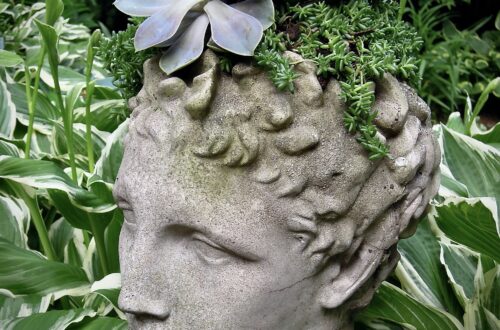
Whether it’s classical urns or pink plastic flamingos, limestone saints or impish ceramic elves, Ionic Styrofoam pedestals or poured concrete birdbaths, you are the curator of your own backyard exhibition.” — Mary Randolph Carter
I believe a garden should be more than rows of groomed beds and well-tended flowers. Just as the interior of a home reveals the personalities of its residents, a garden can reflect the quirks and passions of the people who tend it.
My favorite gardens tend to be “decorated” in the true sense of the word. For instance, I love the little thrill I get when I explore a friend’s herb garden and discover a stone cherub with a broken wing tucked behind the parsley and basil. Or a rusty flea-market bench perched in a bed of roses.
I’m also a huge fan of weathered gates used to support tomato vines, and one-of-a-kind birdbaths crafted by local artists. In other words, I’m a sucker for garden junk.
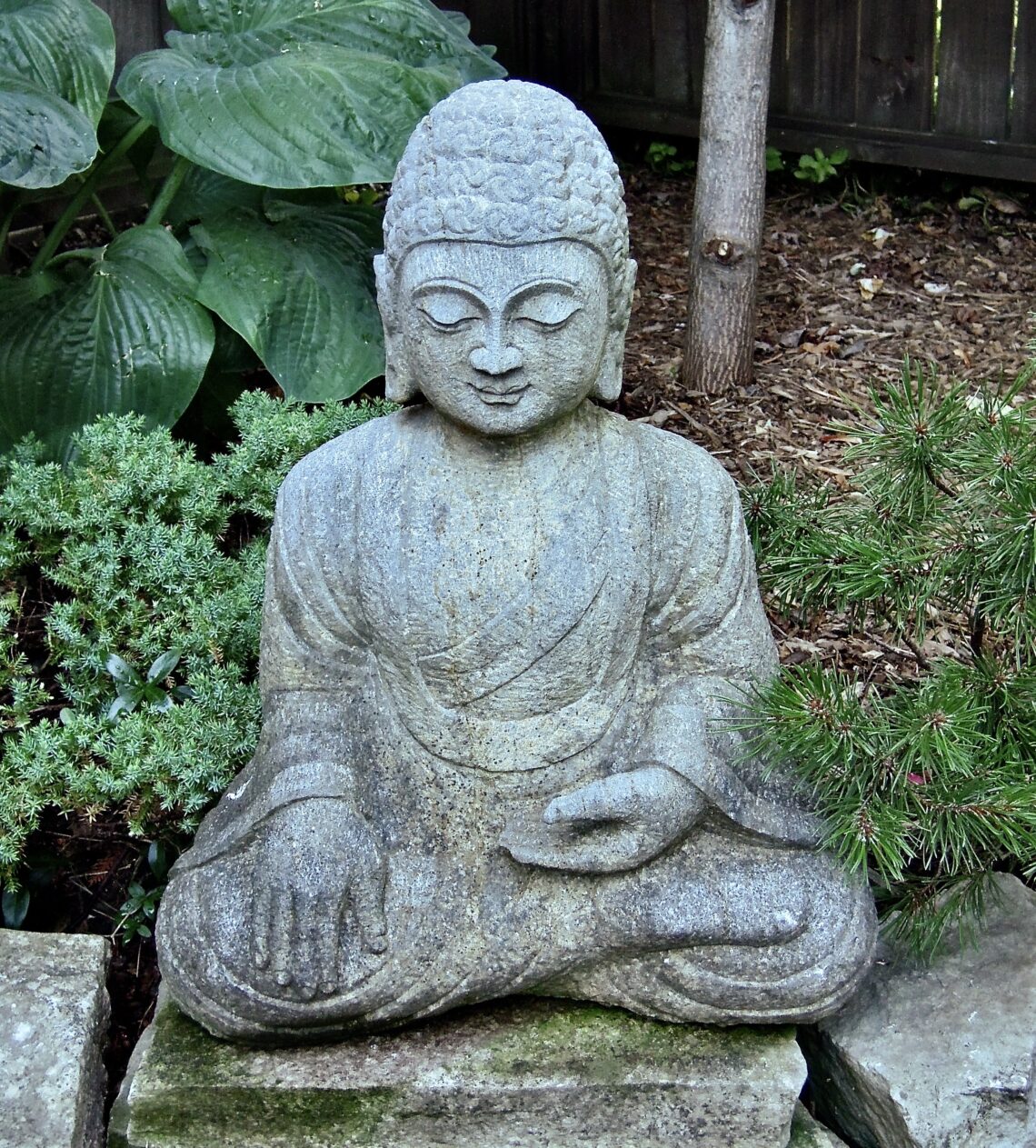
Like the things I’ve collected for my home over the years, most of my garden ornaments have sentimental meaning. Some don’t actually qualify as “junk,” as they were given to me as birthday gifts — including the granite Buddha (from my husband) resting in the Zen garden.
Of course, there’s always room for castoffs in my garden. When my friend Shirley moved to an apartment, she unloaded some of her own garden ornaments in my backyard. One of my favorites is the terracotta rabbit head that peeks out from a
gnarled maple behind the patio.
I miss all my blogging friends this summer, but I hope you’re also outside soaking up some Vitamin D. (Remember, we can sit at our desks all winter and stare at the computer screen while the snow piles up.)
Meanwhile, I’ve been working long hours as an extra in several different film projects since June — quite a diversion from writing, blogging, and
teaching! When I’m not working or looking in on my mother, I try to spend as much time as I can pulling weeds or admiring the blooms of my early summer handiwork. Here’s to summer! – Cindy La Ferle
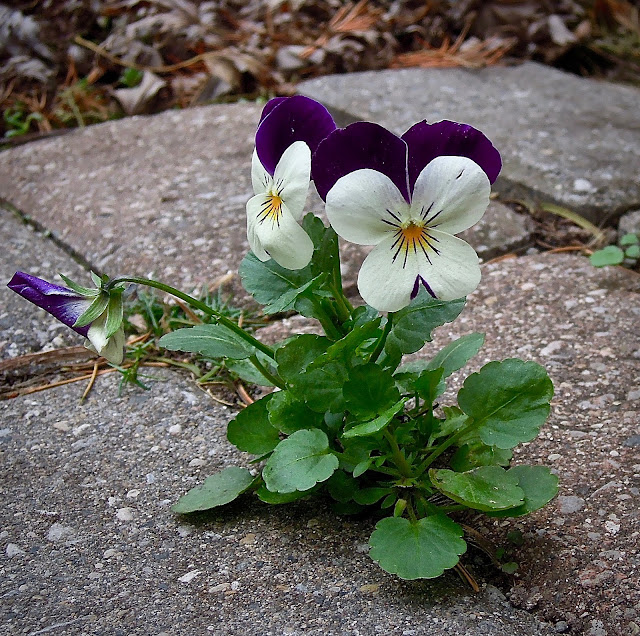
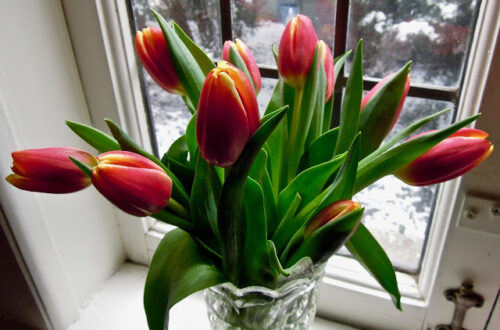
– All photos in this post were taken in my garden. Click each one for a larger view.
Cindy on June 9th, 2010
All my hurts my garden spade can heal.” — Ralph Waldo Emerson
Titled “The Art of Midlife Gardening,” this essay was published in Victoria magazine in the March/April issue this year. With the editor’s permission, I’m sharing the piece with you while I’m off this week…
Last spring, members of our local Master Gardener Society invited me to speak at one of their meetings. I was honored, at first, but as soon as the date of the talk rolled around, I started getting nervous.
And with good reason.
Master Gardeners aren’t just fooling around with bulbs and blossoms. These folks earn a minimum of 40 hours of instruction in horticulture science. Meeting for at least 11 weeks, they take classes in caring for indoor and outdoor plants, establishing lawns, growing vegetables and fruit trees, designing gardens, and more. I bow to their expertise.
Barely getting my hands dirty, I’ve written a few magazine pieces and newspaper columns on my romance with plants and flowers. I’ve shared back-yard memories of sweet peas and apple trees and my grandfather’s ferns. But set me loose with a shovel, and I’m just an eager amateur who’s murdered rose bushes and planted azaleas in the wrong spot.
Regardless, the kindly president of our Master Gardener Society assured me that his group of green thumbs would be open to anything I had to say about writing and gardening. They would humor me — and even offer some tips on deadheading my tulips. Somewhat relieved as I prepared for the talk, it occurred to me that gardens have taught me many valuable lessons. At this stage of my life, especially, gardening is rich with metaphor.
Five years ago, when my husband and I turned 50, our only child left home for college. That same year, we also lost several stately maple trees to disease. The removal of those trees wreaked havoc on our back yard: The lawn was totally destroyed and the surrounding beds were trampled. Not a single root or shoot was left of the delicate woodland shade perennials – trillium, Solomon’s seal, or bleeding heart – that I’d collected over the years.
As every gardener knows, the natural world serves to remind us that change and upheaval are part of the master plan. Likewise, our bulldozed back yard reflected my emotional state as I adjusted to the changes in my menopausal body and my newly emptied nest. For a while there, I felt uprooted in my own household. Yet it also occurred to me that when a new space opens up – by choice or by accident – you have an opportunity to try something else; something you couldn’t do before.
A Japanese garden had been at the top of my wish list for several years, but until all those dead trees were removed, I’d never had the right spot for my dream garden. And so, with the help of a landscaping team, I created a path and some raised beds for my meditation garden, which now includes a small wooden bridge and a dry river of beach stones my husband and I collected from Lake Michigan. The garden has become an outdoor sanctuary, a peaceful escape from my writing deadlines and the clutter inside our home. It’s also living proof to me that middle age can be a signpost to a new life — not just the end of our greener years.
At the end of my talk, I reminded the Master Gardeners that I often struggle with acute writer’s block, or fallow time. I would guess that anyone who’s been doing the same work for so many years does too. Fallow time is the desert where ideas shrivel and evaporate, if they sprout at all. Fallow time is the waiting season, the creative slump, when blue moods hover like pending thunderstorms. During fallow time, we can turn to the garden for another lesson.
Michigan winters are incredibly long and dull. For those of us who battle the blues, it’s easy to believe that spring might forget us on its way north. But just when things can’t get any gloomier, usually in early April, along comes a balmy 60-degree day — a day drenched in the scent of moist earth, tulip bulbs, and new grass waking up. Suddenly, a glimmer of hope breaks through, melting all those months of doubt and dejection. The frozen river thaws. Possibility stirs. And that when I know it’s time to grab my tools, dig in, and begin again. — Cindy La Ferle
–Reprinted with permission from Victoria magazine. All garden photos copyrighted by Cindy La Ferle. Please click on each photo for a larger view. –
Cindy on May 28th, 2010
The windows of my soul I throw wide open to the sun.” — John Greenleaf Whittier
Dear Friends,
If you’ve been reading my blog for a while, you know I spend less time hanging out here in the Home Office when it’s warm outside. The laptop stays indoors and I don’t.
In summer, I try to limit my time online to less than an hour daily, mainly to check e-mail for work-related issues. (I still work on other writing projects year ’round.) This officially qualifies me as a fair-weather blogger, I know. Not only does summer coax me out to my garden and the bike trails, it also brings more opportunities to work as a background extra in films. (So far, I have four bookings for shoots in June and July.)
But I won’t disappear completely. While I’m cutting back to three posts per month this summer, I still want to share some things with you. For starters, I have permission to share an excerpt of my new garden essay that ran exclusively in Victoria magazine. And since a couple of my essays are included in some brand-new story collections, I’ll plug the books when they’re available. Come Father’s Day, I’ll run a favorite Daily Tribune column about my dad and a special photo taken on Father’s Day before he died in 1992. And later, I’ll post a photo essay featuring one of my crazier passions — garden junk!
Meanwhile, if you enjoy the short essays I typically feature here, I hope you’ll track down a copy of Writing Home in bookstores or on Amazon. I’ll miss you, and would love it if you’d stop by to say hello. But I’ll understand if you can’t. I hope you’ll be outside in the sunshine, too, taking a break to read a novel in your lawn chair, or pausing to admire what’s growing in your own garden. Warmest wishes for a happy summer, Cindy
P.S. Look for my monthly “Somewhere in the Middle” column at Michigan Women’s Forum — and watch for a special giveaway at the end of May.
– Photos (copyright 2010 by Cindy La Ferle) were taken last year in my garden. –
Cindy on April 19th, 2010
The greatest gift of the garden is the restoration of the five senses.” ~Hanna Rion
Spring reminds us that we humans were not designed to hunker down in front of a computer monitor for days on end. At some point, we must wake up and engage all of our senses. We need to feel the sun on our backs and to inhale the scents of plants and rich earth.
My own garden has always been a place of healing and renewal. I’m deeply nourished by kneeling in the grass, working the soil, and tending new growth. By the the end of April, I can hardly wait to dig in — and my heart pumps peanut butter every time I drive past a local garden center or nursery. It’s all I can do to refrain from planting too early.
I’m really looking forward to expanding the herb garden outside our back door when the real danger of frost is past. In the meantime, I’m soaking up these gorgeous lines of Amy Gerstler’s, below. — CL
In Perpetual Spring
by Amy Gerstler
Gardens are also good places
to sulk. You pass beds of
spiky voodoo lilies
and trip over the roots
of a sweet gum tree,
in search of medieval
plants whose leaves,
when they drop off
turn into birds
if they fall on land,
and colored carp if they
plop into water.
Suddenly the archetypal
human desire for peace
with every other species
wells up in you. The lion
and the lamb cuddling up.
The snake and the snail, kissing.
Even the prick of the thistle,
queen of the weeds, revives
your secret belief
in perpetual spring,
your faith that for every hurt
there is a leaf to cure it.
–Reprinted from Bitter Angel, by Amy Gerstler; New York: North Point Press; 1990.–
– Garden photo by Cindy La Ferle –
__________________________________________________
BLOG TOUR ALERT: If you missed a chance to win a free copy of my book, Writing Home, on other tour
stops, here’s another. Click here to read Angie Muresan’s review and to participate in her giveaway this week. I’ve always enjoyed Angie’s view on life — and I think you will too.
_____________________
Cindy on January 31st, 2010
I believe that there is a subtle magnetism in Nature, which, if we unconsciously yield to it, will direct us aright.” ~Henry David Thoreau
When I was a student at Michigan State University in the 1970s, three natural science courses were required of all liberal arts students.
An artsy kid, I’d nearly flunked math and biology in high school. So I was terrified, initially, by MSU’s rigid science requirement. But thanks to a very creative counselor who supervised my independent study track, I was allowed to replace the final natural science class with a graduate-level botany course in my senior year.
I was born with a green thumb, so this was both a thrill and a relief. The class required several field trips to outdoor nature centers, which I thoroughly enjoyed. Throughout the term, I learned to identify a wide variety of plant life, and even memorized the Latin names of species. I collected leaves, seed pods, and mushrooms. I sniffed berries and wildflowers. I learned that nature is an intelligent system; more than a thing of beauty in a controlled suburban landscape. Understanding and respecting that system — the miraculous cycle of decay and regeneration — has gotten me through some of the roughest times in my life.
But I digress. Botany was a blast — and guess what? I ended up with the top grade in the class — the first (and only) 4.0 I ever earned in a science curriculum. I’m still proud of that grade, and awed by the fact that so much of what I learned in a botany class serves me well to this day.
My love affair with plants is reflected in the Botanic Garden dish set my family uses now.
Produced by the Portmeirion Pottery company in Great Britain, the Botanic Garden pattern first caught my eye when I was outfitting my first apartment after college graduation. Durable and beautifully crafted, the designs were inspired by original 19th-century botanical drawings, replete with the Latin name of each plant. But the imported dishes were way out of my price range at the time. I was newly employed as a research assistant for a reference book publisher in Detroit, earning an annual income of $7,500.
Margaret, a favorite room mate from MSU who shared the post-grad apartment with me, bought my first Botanic Garden cup and saucer for my birthday in 1979. “If I know you as well as I think I do, then I’m sure you’ll find a way to get the whole set one day,” Margaret wrote on the card that came with the gift.
I didn’t have the nerve to register for the Botanic Garden pattern when I got engaged 30 years ago; Doug and I thought it was too much to ask of our wedding guests during an economic recession. But over the years, we managed to acquire a full set. Luckily, the price of the dishes started coming down in the last decade, and we found several pieces on sale at discount stores and Bed Bath & Beyond. We’ve also received a few of the serving pieces as holiday gifts.
Typing this, I realize it might seem silly or frivolous to romanticize plant science or a set of dishes. But at the end of a very difficult week, awaiting test results for my widowed mother’s worrisome health issues, I find comfort in these simple, ordinary pleasures. And Margaret was right. When you want something badly enough and your heart is in the right place, you’ll find a way to get it. That includes meeting academic challenges — and acquiring expensive dinnerware. — Cindy La Ferle
– Photos by Cindy La Ferle –