Now in Bookstores and Online
My newest book, Writing Home, is currently available on Amazon.com. Proceeds from new book sales are donated to organizations serving the homeless in Oakland County, Mich.
Writing Home is also available at the Yellow Door Art Market in downtown Berkley, Mich.
Cindy La Ferle on May 23rd, 2013
I went from resenting my mother-in-law to accepting her, finally to appreciating her. What appeared to be her diffidence when I was first married, I now value as serenity.” — Ayelet Waldman
Earlier this week, The Wall Street Journal ran a feature stating the obvious: “Mothers worry more when sons marry than when daughters marry,” according to researcher Sylvia Mikucki-Enyart.
Duh. I’m hardly a leader in the field of social psychology, but I’ve telling my son Nate the same thing ever since he married last fall.
Even in the happiest circumstances, the family dynamic changes significantly when adult children marry. Whether we’re debating where to spend the holidays or how often to phone the newlyweds, everyone has to adjust or compromise.
Google the term “mother-in-law,” and you’ll find dozens of crude mother-in-law jokes and blogs describing toxic in-laws from hell. From Joan Rivers, for instance: “I told my mother-in-law that my house was her house, and she said, ‘Get the hell off my property.’” Cast as the witch in American family mythology, the stereotypical mother-in-law is blamed for poisoning marriages and spoiling grandkids. No matter what she says or does, she’s the proverbial scapegoat at the extended-family dinner table.
Of course, I want to avoid becoming this woman at all costs. Thankfully, I can revisit my own family tree for positive role models.
When I married 32 years ago, I felt awkward around my husband’s mother, an emotionally distant woman whose personality was so different from mine. At the time, my own mother was quick to remind me that a cozy relationship with one’s in-laws rarely evolves overnight.
Early in her marriage, Mom was uncomfortable with my dad’s mother, Ruby, a dowdy Scottish immigrant and teetotaler. Ruby was the polar opposite of my mother’s alcoholic parents, and her brogue was so thick that my mother wished she could hire a translator.
Over time, however, Mom learned Ruby’s language of unconditional love and often turned to her in times of crisis. Serving comfort and counsel with bottomless pots of tea, Ruby provided the maternal stability my mother always lacked.
My new daughter-in-law, Andrea, hails from a happy family with solid Croatian roots, and isn’t the sort who’ll need Scottish-island wisdom or scone recipes. Having watched her grow up with Nate through high school and college, I’m proud of the capable young woman she’s become.
Given such a blessing, who wouldn’t strive to be the world’s best mother-in-law?
Nate reminds me that I’m “over-thinking” this phase of parenthood — a habit I can blame on my career as a family columnist. Even so, if he’s lucky enough to be a father someday, he’ll find that letting go of one’s children is the trickiest step to learn in the circle-dance of life.
All said and done, most of us have watched enough Dr. Phil to know we shouldn’t meddle in the lives of our married children, and we know that our new extended family is likely to bring different customs to the table.
But I believe the rest is up to each of us: We decide how much love and effort to invest in our key relationships.
Meanwhile, I want my new daughter-in-law to know that I’ll never compete for my son’s attention; I’ll do my best to respect her boundaries. Yet I want to be at the top of her list of women she can count on. And as our family’s future unfolds, I hope she’ll turn to me whether she needs a book recommendation or a babysitter — or someone who will listen with an open heart.
Parts of this column originally appeared in Michigan Prime magazine, February 2013.
–Top photo: That’s me helping my son Nate with his boutonniere, moments before his wedding.–
Cindy La Ferle on May 16th, 2013
I always pass along good advice. It is the only thing to do with it, since it is never of any use to oneself.” – Oscar Wilde
It’s graduation season. The flowering trees are in bloom, everywhere, and suddenly I’m flooded with sweet memories of my son’s baccalaureate ceremonies at Shrine High School (2004) and the University of Notre Dame (2008).
Of course, I’ve got an album crammed with photos documenting both events. In one of my favorite pictures, Nate stands tall under incredibly blue skies. He looks proud, relieved, and a little awkward as he balances the mortarboard on his head.
This is the time of year when parents, mentors and elected officials like to pass along pithy nuggets of wisdom or advice to students who’ll be starting college or launching new careers. To all our local graduates of 2013, I send my very best wishes for your future. Meanwhile, here’s a rehash of the Survival Tips I wrote for Nate before he left for college.
*Relationships, like cars, need regular upkeep. Maintain the good friendships you’ve made.
*Learn from your adversaries. The people who push our buttons tend to reflect qualities we dislike in ourselves.
*Encourage others to talk about themselves. You’ll make a great first impression and learn something new.
*If you settle for less, that’s exactly what you’ll get. Strive for decency and expect nothing less from everyone you hang out with.
*The notion that everyone is having a better time somewhere else is one of the world’s dumbest illusions. Refuse to believe it.
*Losing is a great character builder. If your best effort misses the mark, ask yourself what you can learn from the loss.
*Choose a career you can be proud to list on every form you’ll have to fill out.
*Be a community builder. If we can’t make peace with our neighbors, there’s no hope for the rest of the world.
*It can be lonely at the top. Be careful not to alienate loved ones while achieving your goals.
*Be thoughtful. Good manners were designed to make others feel comfortable and respected.
*Get enough sleep.
*Show up or don’t sign up. Make good on your word. Never volunteer out of guilt or for personal gain; give from the heart.
*Keep your faith, but learn about the great religions of the world. Never publicly criticize someone’s religious beliefs. Self-righteousness is a huge turn-off.
*Stay in shape; enjoy a recreational sport.
*Spend time alone. Creative ideas and solutions are sparked in solitude.
*Never leave your underwear on the floor. As every good room mate will tell you, neatness is essential in cramped spaces.
*Always take the high road. Admit your blunders and apologize if you’ve hurt someone.
*Return what you borrow.
*Go easy on the junk food. Pay attention to what you eat, where it came from, and why you’re eating it.
*Find your inner compass and stop seeking approval from others. Be too busy to wonder what other people think of you.
*Spend time outdoors. A walk in the woods is the best antidepressant.
*Splurge on comfortable shoes.
*Don’t limit your shopping to chain stores. Support local businesses and discover the heart and soul of every new location.
*Travel is the best way to learn about the world, but stay on the lookout for a place to set down roots.
*Savor your memories but don’t live in the past. Anyone who insists their high school or college years were “the best” is stuck in a rut. Life gets richer and juicier as you move on. Enjoy every minute.
A slightly different version of this column was first published in The Daily Tribune in May 2004, and is reprinted in its original form in my book, Writing Home.
Top photo: Graduation day at University of Notre Dame, May 18, 2008. Pictured are Andrea Benda (who became Nate’s wife in September 2012), Nate La Ferle, Doug La Ferle (Nate’s dad) and me.
Cindy La Ferle on May 14th, 2013
“It’s hard not to develop this 21st-century form of anxiety when one glance at your smartphone reveals a thousand awesome things your friends — and enemies — are doing.” — Martha Beck, “The Grass Ain’t Greener”
It’s no secret that I’ve carried on a love-hate relationship with social media for years.
Using LinkedIn as one example: I love how it connects us with colleagues and expands our career-networking potential. Using Facebook as another example: I hate how it tempts us to overplay our achievements or flaunt things that ought to be kept personal.
So far, I’ve been Facebook-free for more than six weeks. The last time I suffered social-media overload, I deactivated my Facebook account for more than three months. In so doing, I discovered I’d suddenly acquired yards of extra free time — simply because I wasn’t reading status updates on what dozens of “friends” had eaten for lunch, bagged at the grocery store, or watched on television the previous night.
At the same time, I’ll admit it feels weird (sometimes) to avoid being part of something that everyone else is doing en masse. Even my husband makes passing references – daily – to material he’s read on Facebook.
It’s enough to stir up an infectious case of FOMO – Fear of Missing Out. Life coach Martha Beck explores the perils of FOMO in her current O Magazine column (June 2013). As Beck explains it, FOMO manages to convince you that everyone else has more fun, more sex, cooler friends, better meals, bigger jobs, smarter kids, and fancier vacations than you have — and is so much younger- or better-looking than you’d ever be. Of course, FOMO rides high and fast on the wheels of social media, in all forms.
“A powerful way to fight FOMO is to recognize that the fabulous life you think you’re missing doesn’t in fact exist,” writes Beck. “When you feel FOMO coming on, remind yourself that practically every image you see on practically any screen is likely misleading.” To find out why, you absolutely must read the rest of Beck’s spot-on article. I promise, you’ll nod your head at every paragraph.
In the meantime, I’m following Beck’s advice and living fully in the ordinary moment – without posting photos of what I ate for breakfast. Seriously, you haven’t missed much.
Tags:
Facebook fatigue,
Fear of Missing Out syndrome,
FOMO,
is facebook bad for culture?,
Martha Beck,
O magazine,
social media overload,
the psychology of social media,
why too much social media is bad for you,
Why you need to stop living online
Read More
Comments (6)
Columns & essays,
Events & news
Cindy La Ferle on May 8th, 2013
When I go into the garden with a spade and dig a bed, I feel such exhilaration and health that I realize I have been defrauding myself in letting others do for me what I should have done with my own hands.” ~Ralph Waldo Emerson
Throughout my life, gardens have provided many spiritual lessons and moments of refuge.
Among them was the fern garden my Scottish grandfather tended in his back yard on Detroit’s west side — an oasis that restored his spirit during the sad summer my grandmother died. The essay I wrote about that garden was published in both British and American editions of Reader’s Digest magazine, and is included in my book, Writing Home.
Today, my own garden is so much more than a plot for herbs and perennials. Working the soil, I’m often mentally untangling one of my elderly mother’s health problems. Or, while preparing a bed for basil and rosemary, I might be digging my way through a stubborn case of writer’s block. Or just daydreaming.
As I reminded my husband recently, gardening is the best therapy I know. (The money I ought to save for a psychiatrist is well spent on garden gadgets and plants at the local nurseries.)
Along these lines, several authors have written inspiring books on gardening as soul work. Here are a few of my favorites.
Praised as a hymn to nature, Diane Ackerman’s Cultivating Delight (HarperPerennial Library) is a sensuous garden memoir. With the keen eye of a naturalist, Ackerman recounts her back-yard discoveries through the seasons, including the time she uncovered a tiny frog asleep inside a tulip.
“By retreating farther and farther from nature,” Ackerman warns, “we lose our sense of belonging, suffer a terrible loneliness we can’t name, and end up depriving ourselves of what we need to feel healthy and whole.”

“No matter how saddened I become by the events of life, when I see the world as a garden, I feel better,” writes author Julie Moir Messervy in The Magic Land: Designing Your Own Enchanted Garden (Macmillan). A landscape designer and consultant, Messervy also sees the garden as a perfect outlet for personal growth. Her book includes exercises to plan your own paradise, whether you want an elaborate storybook garden with a gazebo or a Zen-like oasis. I used many of her tips when I plotted my own Japanese garden a few years ago.
The Sanctuary Garden (Fireside) reminds us that any garden can be a place of reflection. Authors Christopher Forrest McDowell and Tricia Clark-McDowell are founders of the Cortesia Sanctuary for Natural Gardening and Healing in Eugene, Oregon. Their illustrated guide provides tips on attracting wildlife as well as ideas for creating space for prayer and meditation.
“One of the most powerful examples of our relationship to the land came to me when witnessing the end of the war in Bosnia,” writes McDowell. “I was touched to learn that the first act of many of the citizens of Sarajevo was to till and plant their gardens.”
So what are you waiting for? Dust off your garden boots, grab a trowel, ditch your bad mood, and dig in.
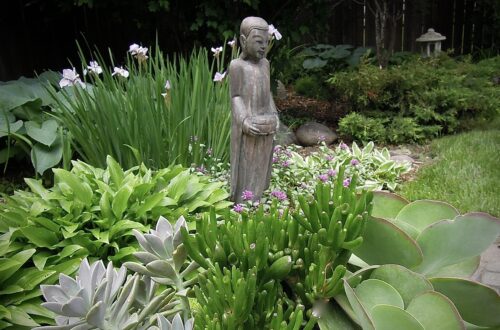
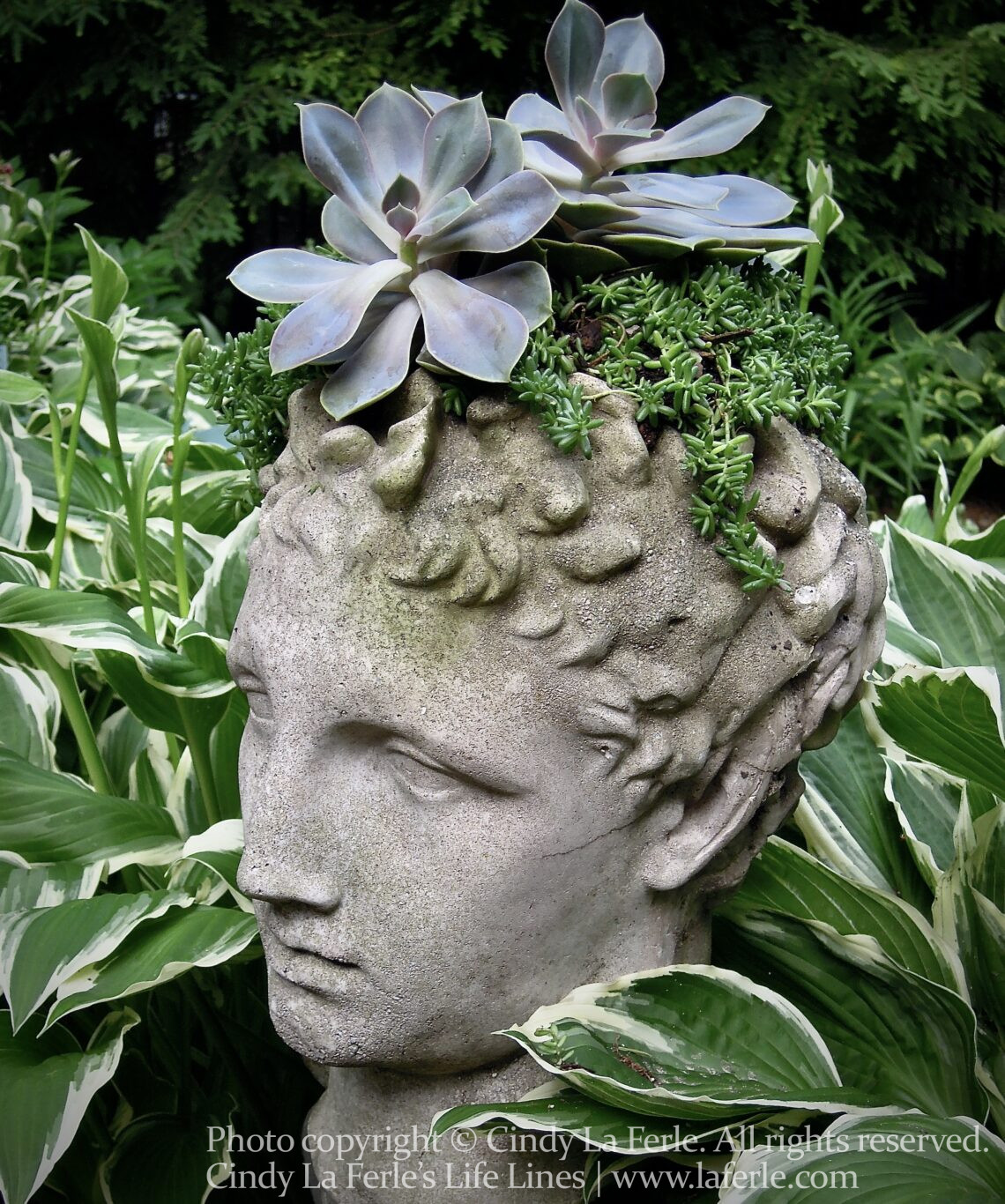
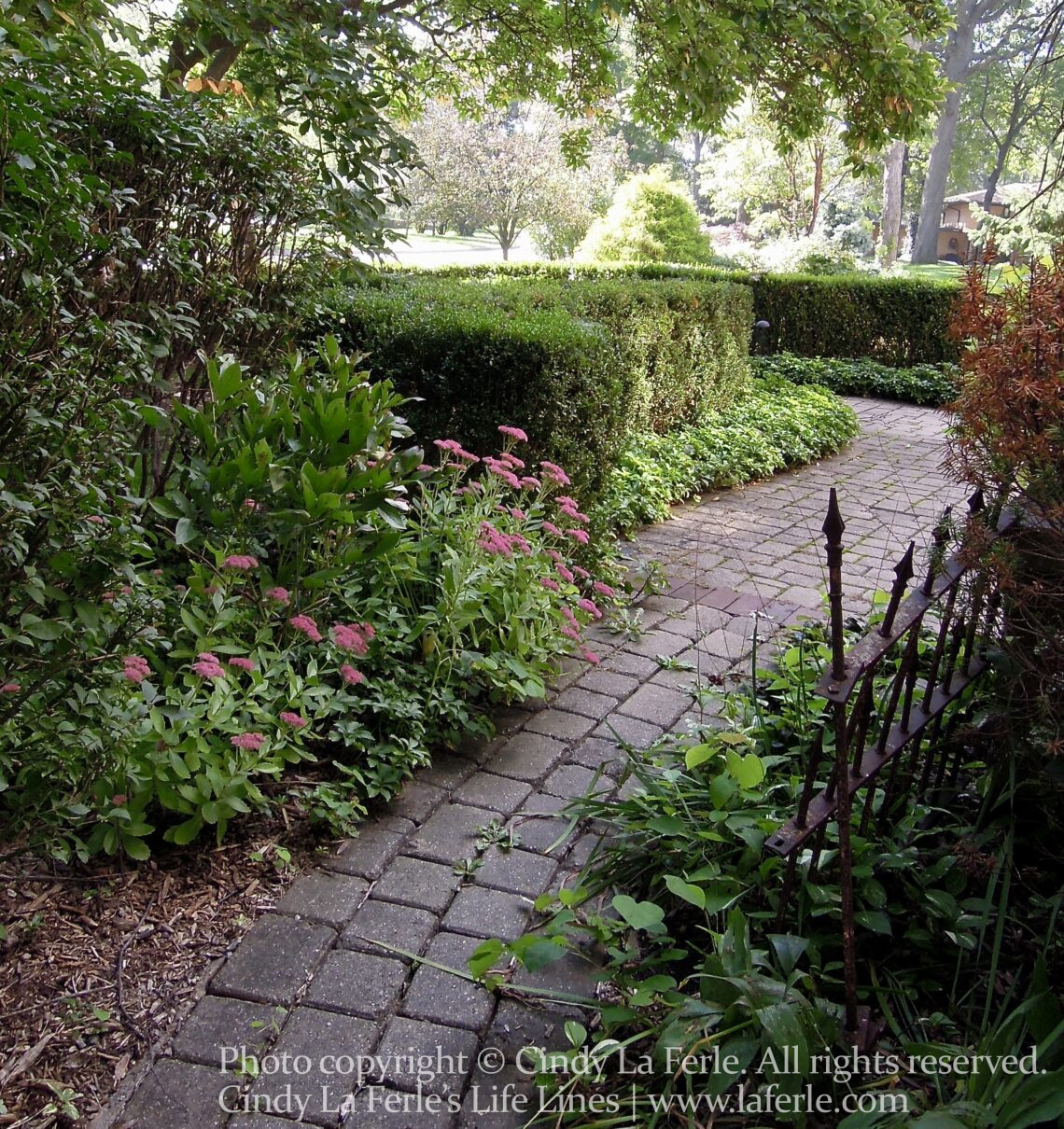
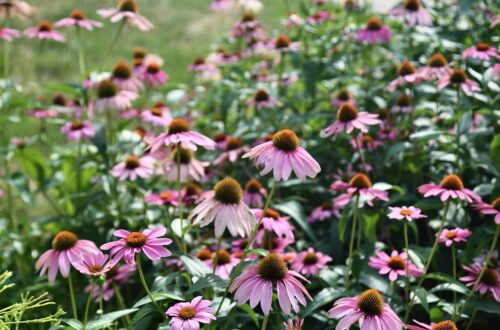
– Garden photos (copyright) by Cindy La Ferle –
Cindy La Ferle on April 29th, 2013
Excuse the mess, but we live here.” — Roseanne Barr
When we moved into our first apartment in 1980, my architect husband and I rarely discussed the delicate issue of housework. Newly married and devoted to our business careers, Doug and I left early for work every weekday morning, tripping over mounds of unfolded laundry and dust bunnies as we headed for the door. We rushed through domestic chores on Saturdays, never quite sure who was responsible for emptying the trash or disinfecting the toilet bowl.
All of this came tumbling back last summer, when I discovered some old books on housekeeping at a second-hand bookstore. Blowing layers of dust from their covers, I was rewarded with some fascinating glimpses of early Americana.
First published in 1924, Good Housekeeping’s The Business of Housekeeping, by Mildred Maddocks Bentley, was a veritable textbook on the domestic arts. Its mildewed, yellowing pages reminded me that household management was once taken seriously. Speaking to young brides, the book covered such topics as “Managing Servants and Housekeepers,” “Dishwashing Three Times a Day,” “Sprinkling and Folding,” and “The Chemistry of Washing.”
As the book’s title suggested, Mrs. Bentley meant business: “The good housekeeper must bring to her task of housekeeping every one of the qualities that make for a successful executive in the downtown business world.”

Another artifact, Housekeeping Made Simple (The Homemaker’s Encyclopedia, Inc.), was published in 1952, two years before I was born. Editor Miriam B. Reichl revealed that, after WWII, women had lightened up a bit and were looking for labor-saving methods. The average housewife, after all, no longer employed domestic help.
Reichl’s book contained some amusing black and white photo-illustrations. One showed a woman smiling broadly (and, yes, wearing high heels and pearls) as she demonstrated several ways to use a vacuum. Another shot featured an attractive woman doing laundry in a satin evening gown. Male models were conspicuously absent.
Back in the late ’70s, when I was single and rented my first apartment, books devoted to home economics (or “Home Eck” as my girlfriends called it) were rare — although my friends and I could have used a few tips on stocking a pantry or planning balanced meals. We left housework to the cleaning fairies.
Even today, few men or women admit they enjoy doing anything remotely domestic, unless it makes them as rich as Martha Stewart. Homemaking is messy business, after all — something we’d rather hire someone else to do if we can afford it.
“You keep a house, but you make a home,” observes anthropology professor Mary Catherine Bateson in Composing A Life (Plume/Penguin). “As we free the ideas of home and homemaking from their links to old gender roles, we can now also draw on metaphors of home to enrich our perceptions of the world.” Home, after all, is where everyone begins.
Of course, I’d never welcome another era in which women have few career options beyond vacuuming. And I’d hate to see ironing raised to an art form. But I agree with Bateson when she suggests that we lose our sense of place — the foundation that keeps us grounded — when we neglect the home front. The driveway becomes a mere parking lot; the house exudes an atmosphere as impersonal as a chain motel.
Lately I’ve noticed a new crop of home-care guides in local bookstores. These books are saturated with a deep yearning for the comfort of roots and shelter. Unlike their predecessors, they’re refreshingly devoid of sexism, though women will most likely buy them. Whether or not younger Americans will embrace a homemaking revival remains to be seen. Right now, we’re still arguing over whose turn it is to clean the bathroom.
–Part of this essay is excerpted from my column collection, Writing Home, now available in Kindle and print editions on Amazon.com —
Tags:
Composing A Life,
domestic arts,
family life in Royal Oak MI,
history of housework,
homekeeping,
Mary Catherine Bateson,
sexism and housekeeping,
vintage housekeeping books,
women and chores,
Writing Home by Cindy La Ferle
Read More
Comments (4)
Book reviews,
Columns & essays