Archive for the ‘Poems to inspire’ Category

Begin

Seat yourself next to your joy.” — Rumi

We all have to start somewhere. Truth is, the beginning is often the hardest part of any worthy project, whether we’re talking about writing books, designing clothes, breaking a habit, or plotting a garden. Before we can meet a deadline or plant the first seed, we have to face the proverbial blank page or fallow field.

So what the heck is stopping us?

Always a good excuse: kids to raise; dogs to walk; bathrooms to scrub; naps to take; debts to pay; day jobs that wring us dry. Fear can be a factor, too — fear of failure or fear of success. Maybe we can’t top the last amazing thing we did. Maybe our friends and families will resent our attempts to bloom or grow or shine (as if there’s never enough good stuff to pass around the table). Maybe someone will point out our mistakes and try to shrink us back down to size.  Or maybe we’ll have to break free from the sweet safety of an old comfort zone.

Rumi’s poem challenges us to forget the excuses — and to weed the naysayers from our gardens. We’re called to do what makes us happy. To wake up and begin, right now. – CL

BEGIN

By Jalal al-Din Rumi; translation by Coleman Barks

This is now. Now is. Don’t
postpone till then. Spend

the spark of iron on stone.
Sit at the head of the table;

dip your spoon in the bowl.
Seat yourself next to your joy

and have your awakened soul
pour wine. Branches in the

spring wind, easy dance of
jasmine and cypress. Cloth

for green robes has been cut
from pure absence.  You’re

the tailor, settled among his
shop goods, quietly sewing.

–Reprinted from The Soul of Rumi, translation by Coleman Barks (HarperCollins); 2001

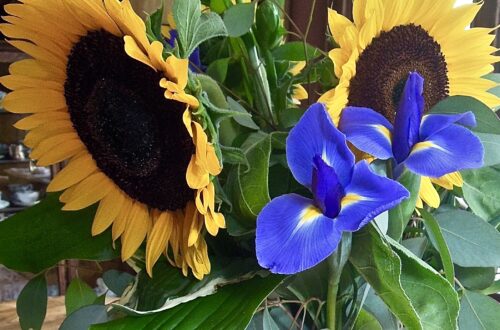
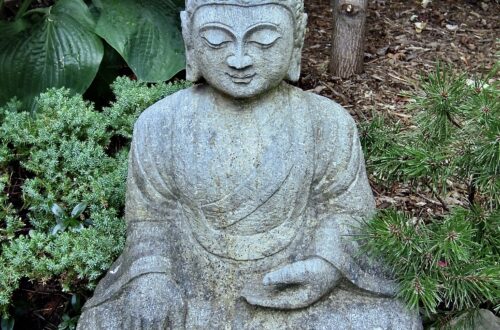
– Garden photo by Cindy La Ferle –

permalinkRead More CommentComments (12) CatPoems to inspire

Now I Become Myself

I have been dissolved and shaken / Worn other people’s faces”  — May Sarton

My early introduction to May Sarton’s work was through her diary, Journal of a Solitude.  I was new to personal writing at the time, and I admired how Sarton gracefully shared her private and public worlds — her beloved garden; domestic life in New Hampshire; her conflicting needs for solitude and companionship. Reading more of her work over the years, I knew I’d found a kindred spirit.

“Now I Become Myself” first struck me as a song of elder wisdom, a declaration of authentic power. Feeling her “own weight and density,” the poet has outgrown the petty insecurities of youth — including its sense of urgency. Yet the poem speaks to readers of all ages. I gave it to a friend on her 70th birthday and was thrilled to learn it is now one of her favorites.  My friend was especially moved by the line, “Now there is time and Time is young.”  Which lines speak to you? –CL

Now I Become Myself
By May Sarton

Now I become myself. It’s taken
Time, many years and places;
I have been dissolved and shaken,
Worn other people’s faces,
Run madly, as if Time were there,
Terribly old, crying a warning,
“Hurry, you will be dead before—”
(What? Before you reach the morning?
Or the end of the poem is clear?
Or love safe in the walled city?)
Now to stand still, to be here,
Feel my own weight and density!
The black shadow on the paper
Is my hand; the shadow of a word
As thought shapes the shaper
Falls heavy on the page, is heard.
All fuses now, falls into place
From wish to action, word to silence,
My work, my love, my time, my face
Gathered into one intense
Gesture of growing like a plant.
As slowly as the ripening fruit
Fertile, detached, and always spent,
Falls but does not exhaust the root,
So all the poem is, can give,
Grows in me to become the song,
Made so and rooted by love.
Now there is time and Time is young.
O, in this single hour I live
All of myself and do not move.
I, the pursued, who madly ran,
Stand still, stand still, and stop the sun!

– Reprinted from Selected Poems of May Sarton edited by Serena Sue Hilsinger and Lois Brynes; W.W. Norton & Company; 1978–

–Top photo: Detail from “Book of Shadows,” an altered book, by Cindy La Ferle –

This post is part of a weekly poetry appreciation series.  To read more, please click on “Poems to inspire” in the CATEGORIES column at right. As always, I welcome your recommendations, too.

permalinkRead More CommentComments (13) CatPoems to inspire

Against Hesitation

Make music of what you can.” — Charles Rafferty

I always knew I wanted to be a writer. When I was a kid, I perched in the gnarly apple tree in my backyard and scribbled my own adventures in a ruled notebook. In college I majored in English and journalism, but it took years before I found the courage (not to mention the income) I needed to begin a real writing career.

The long path that led me here was marked with detours and littered with excuses. The poem below is the wake-up call I needed 25 years ago — but Charles Rafferty hadn’t written it yet. Today I keep it in my back pocket and read it whenever I need a creative kick in the pants.

What dream would you launch if you had all the time in the world? Where would you travel if you knew the road was wide open? What’s fueling your hesitation? –CL

Against Hesitation
By Charles Rafferty

If you stare at it long enough
the mountain becomes unclimbable.
Tally it up. How much time have you spent
waiting for the soup to cool?
Icicles hang from January gutters
only as long as they can. Fingers pause
above piano keys for the chord
that will not form. Slam them down
I say. Make music of what you can.
Some people stop at the wrong corner
and waste a dozen years hoping
for directions. I can’t be them.
Tell every girl I’ve ever known
I’m coming to break her door down,
that my teeth will clench
the simple flower I only knew
not to give … Ah, how long did I stand
beneath the eaves believing the storm
would stop? It never did.
And there is lightning in me still.

Reprinted from A Less Fabulous Infinity, by Charles Rafferty (Louisiana Literature Press; 2006)

–Photo: detail from a mixed-media collage by Cindy La Ferle –

This post is part of a weekly series of poetry appreciation.  To read more, please click on “Poems to inspire” in the CATEGORIES column at right.  I welcome your recommendations, too.

permalinkRead More CommentComments (14) CatJust for writers, Poems to inspire

Unending Love

My spellbound heart has made and remade the necklace of songs” — Rabindranath Tagore

Valentine’s Day is coming, and I’ll be the first to admit it can be a guilt-inducing Hallmark holiday. As hard as I try to avoid playing the sentimental fool, lately I’ve been jumping at any chance to celebrate the people I cherish. I’ve lost a few in recent years — so I’m burying old grudges and trying not to leave any of my love unsaid.

Reading Tagore’s “Unending Love” for the first time, I knew it was the perfect poem to give my husband, whose birthday falls on Valentine’s Day. Doug and I met in art class in ninth grade, and immediately felt as if we’d been best friends for ages. We married several years later, after college, and we’ll gratefully celebrate our 30th anniversary this year.

This poem was Audrey Hepburn’s favorite, and if you click here, you’ll hear a reading dedicated to her by Gregory Peck. Love to all! – CL

Unending Love
By Rabindranath Tagore

(Translated by William Radice)

I seem to have loved you in numberless forms, numberless times
In life after life, in age after age, forever.
My spellbound heart has made and remade the necklace of songs,
That you take as a gift, wear round your neck in your many forms,
In life after life, in age after age, forever.

Whenever I hear old chronicles of love, its age-old pain,
Its ancient tale of being apart or together,
As I stare on and on into the past, in the end you emerge
Clad in the light of a pole-star, piercing the darkness of time:
You become an image of what is remembered forever.

You and I have floated here on the stream that brings from the fount
At the heart of time love of one for another.
We have played along side millions of lovers, shared in the same shy sweetness of meeting,
the same distressful tears of farewell –
Old love, but in shapes that renew and renew forever.

Today it is heaped at your feet, it has found its end in you,
The love of all man’s days both past and forever:
Universal joy, universal sorrow, universal life,
The memories of all loves merging with this one love of ours –
And the songs of every poet past and forever.

–Reprinted from Selected Poems, by Rabindranath Tagore (with an introduction by William Radice); Penguin Classics; 2005

This post is part of a new weekly poetry appreciation series.  For more poetry, please click on “Poems to inspire” in the CATEGORIES column at right.

– Photo: detail from a collage by Cindy La Ferle –

permalinkRead More CommentComments (10) CatPoems to inspire

Advice to Writers

The more you clean, the more brilliant your writing will be.” — Billy Collins

Last week I shared Jane Hirshfield’s “The Poet” (about a writer at her desk), and in the comment section we all compared notes on where we do our own creative projects.

Writers are inherently messy — in a good way. We save scraps of paper scribbled with notes and ideas. We collect more pens and blank journals than we’ll ever use. And when we’re in the middle of editing an article or composing a poem, we litter and trash our workspace. But I’m not convinced that’s what Billy Collins is talking about in the poem below.

It’s open to interpretation, of course, but I like to think Collins is playing with the idea of clearing the mind to make room for fresh ideas. Each time I begin a new project or assignment, for example, I need to push past my fears, self-imposed limits, and creative road blocks.

Or maybe Collins is talking about writing rituals — the small acts we must perform (procrastination?) before we can lift our “yellow pencil.”  What do you think? In any event, I think you’ll agree that Collins has both a wicked sense of humor and a knack for spotting the beauty in the ordinary. –CL

ADVICE TO WRITERS
By Billy Collins

Even if it keeps you up all night,
wash down the walls and scrub the floor
of your study before composing a syllable.

Clean the place as if the Pope were on his way.
Spotlessness is the niece of inspiration.

The more you clean, the more brilliant
your writing will be, so do not hesitate to take
to the open fields to scour the undersides
of rocks or swab in the dark forest
upper branches, nests full of eggs.

When you find your way back home
and stow the sponges and brushes under the sink,
you will behold in the light of dawn
the immaculate altar of your desk,
a clean surface in the middle of a clean world.

From a small vase, sparkling blue, lift
a yellow pencil, the sharpest of the bouquet,
and cover pages with tiny sentences
like long rows of devoted ants that followed you in from the woods.

–Reprinted from The Apple That Astonished Paris, by Billy Collins (The University of Arkansas Press); 1988

This post is part of a new weekly poetry appreciation series.  To read more, please click on “Poems to inspire” in the CATEGORIES column at right.

– Top photo “Blue Glass” (copyrighted) by Cindy La Ferle –

permalinkRead More CommentComments (14) CatBlogs and shorts, Poems to inspire
CSS Template by RamblingSoul | Tomodachi theme by Theme Lab